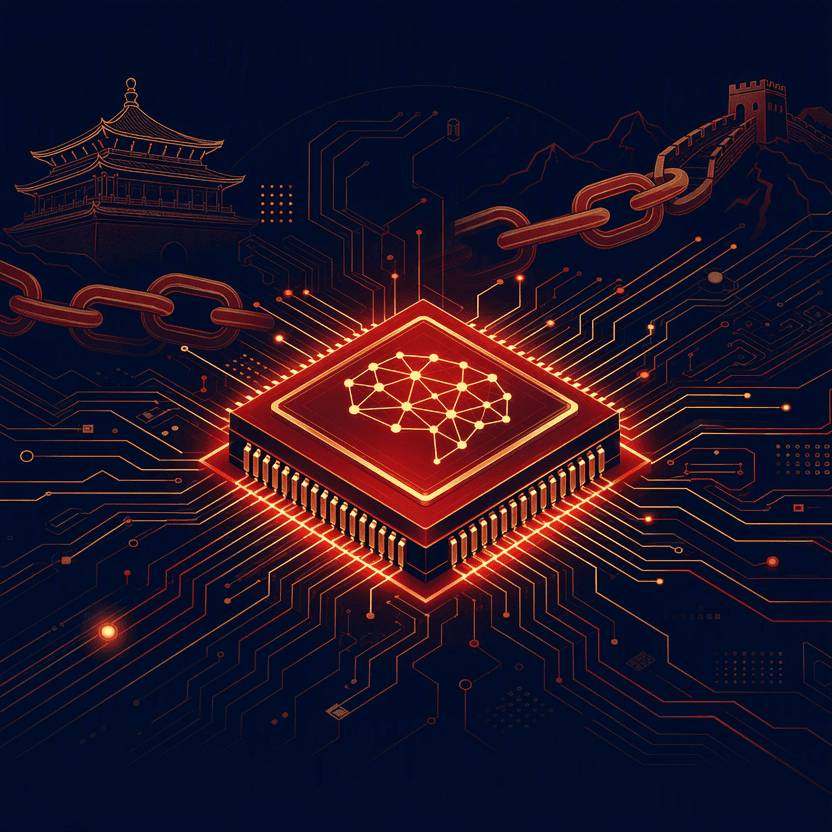
China’s Zhenwu V900 AI accelerator is not just another GPU - it represents a deliberate full-stack strategy from chip to framework. What it does, how it compares and what it means for the global AI landscape.
Amid US export controls cutting off access to NVIDIA’s top GPUs, China accelerated its domestic AI chip program. The Zhenwu V900 is the most capable result yet - and it represents more than a single chip. It embodies a full-stack strategy spanning silicon, interconnect, software and cloud.
What the V900 delivers
- Compute: 1.8 PFLOPS FP16 - roughly comparable to NVIDIA H200 for training workloads
- Memory: 128GB HBM3 with 4.8 TB/s bandwidth
- Interconnect: proprietary Z-Fabric linking 1,024 chips in a cluster with 200 Gbps per-node
- Software: full CUDA translation layer plus native support for PyTorch, TensorFlow and Chinese frameworks (PaddlePaddle, MindSpore)
The full-stack approach
What makes China’s strategy different from simply cloning NVIDIA:
- Own the silicon - SMIC 7nm process, domestic design, no dependence on TSMC or US tooling
- Own the interconnect - Z-Fabric replaces NVLink for cluster-scale communication
- Own the software - CUDA translation means existing AI code runs without modification
- Own the cloud - Alibaba Cloud, Tencent Cloud and Huawei Cloud all offer V900 instances
This end-to-end control means China can build complete AI infrastructure independent of US technology restrictions.
How it compares
| Dimension | Zhenwu V900 | NVIDIA H200 | AMD MI355X |
|---|---|---|---|
| Peak FP16 | 1.8 PFLOPS | 1.98 PFLOPS | 2.1 PFLOPS |
| Memory | 128GB HBM3 | 141GB HBM3e | 288GB HBM3e |
| Bandwidth | 4.8 TB/s | 4.8 TB/s | 8.0 TB/s |
| Cluster scale | 1,024 chips | 72 chips/rack | 8 chips/platform |
| Software | CUDA translation + native | CUDA native | ROCm |
The geopolitical dimension
The V900 is not competing on raw specifications - it is competing on availability. US export controls prevent Chinese organizations from buying NVIDIA hardware. The V900 fills that gap with domestic supply, and is now being exported to countries in China’s sphere of influence.
For organizations outside the US-China duopoly (like Thailand), this creates both opportunity and complexity: more vendor choice, but also ecosystem fragmentation.
What this means for the industry
- End of monopoly - NVIDIA’s near-monopoly on AI training hardware is effectively over
- Price pressure - competition drives down costs across all vendors
- Ecosystem choice - organizations must decide which software ecosystem to invest in
- Supply chain resilience - having alternatives reduces single-vendor risk
Devsign helps organizations navigate AI hardware choices - from NVIDIA to AMD to emerging alternatives, matched to your actual workloads.