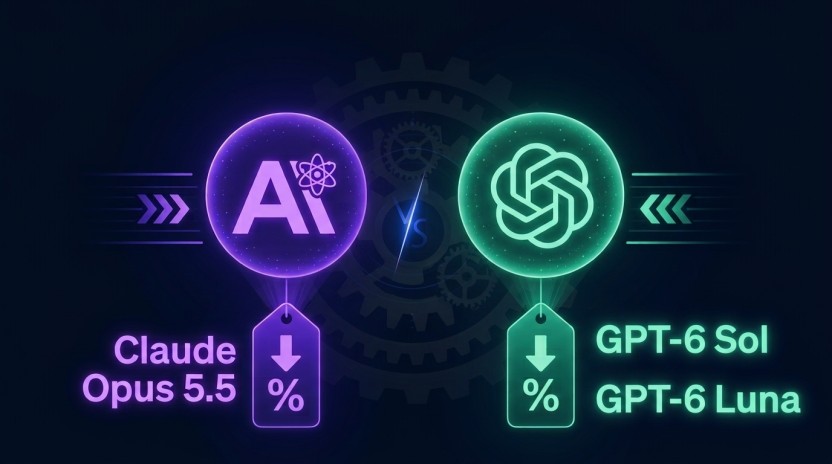
Anthropic cuts Claude Opus 5.5 pricing by 40% while OpenAI halves GPT-6 Sol costs - what the aggressive price competition means for enterprises building AI systems.
In a move that surprised the industry, Anthropic cut Claude Opus 5.5 pricing by 40% and OpenAI responded by halving GPT-6 Sol costs. The AI price war is no longer about who has the best model - it is about who can sustain the lowest cost per token while maintaining quality.
What changed
| Model | Old price (input/1M) | New price | Change |
|---|---|---|---|
| Claude Opus 5.5 | $5.00 | $3.00 | -40% |
| GPT-6 Sol | $2.50 | $1.25 | -50% |
| Claude Sonnet 5 | $3.00 | $2.00 | -33% |
Why they are cutting prices
- Competition from open models - Qwen and DeepSeek deliver comparable quality at $0.04-0.20/1M, forcing commercial providers to justify their premium
- Hardware efficiency - newer inference hardware (Rubin, MI350) cuts per-token compute cost dramatically
- Market share battle - the enterprise AI market is consolidating; whoever locks in customers now owns the ecosystem
What this means for enterprises
Positive
- AI-powered products become economically viable for use cases that were too expensive last year
- Multi-model strategies (routing simple tasks to cheap models, complex to premium) become more effective
- ROI calculations improve across the board
Cautionary
- Prices may rise again - after market consolidation, the remaining players have pricing power
- Quality variance - cheaper does not always mean the same quality; benchmark with your actual workloads
- Lock-in risk - building deeply on one provider’s proprietary features makes future price increases painful
The strategic response
The smartest approach: design for model portability. Use an AI gateway that routes to whatever model is best-value at the moment. Keep your prompts, data pipeline and evaluation suite model-agnostic. Then price wars benefit you instead of trapping you.
Devsign designs model-portable AI architectures with AI gateways that keep you flexible as the market evolves.