Thailand is an AI user, not an AI builder - so its risks look different: data sovereignty, PDPA security, employment impact, infrastructure strain and a legal framework still catching up.
When people hear "AI risk" they imagine robot overlords. For Thailand, the real risks sit in much closer dimensions. The country is mostly a "user and integrator" of advanced AI rather than a "builder" - so its risk profile differs completely from nations that train frontier models themselves.
1. Sovereignty and control risk (highest level)
Thailand imports its core models from abroad (OpenAI, Anthropic, Google, Qwen, DeepSeek) and deploys them in critical systems - banks, hospitals and government services. The risks:
- Limited model auditability - we cannot fully know what data the models were trained on or what hidden biases they carry
- Heavy external dependence - if a foreign vendor changes policy, shuts a service or faces sanctions, Thai systems feel it immediately
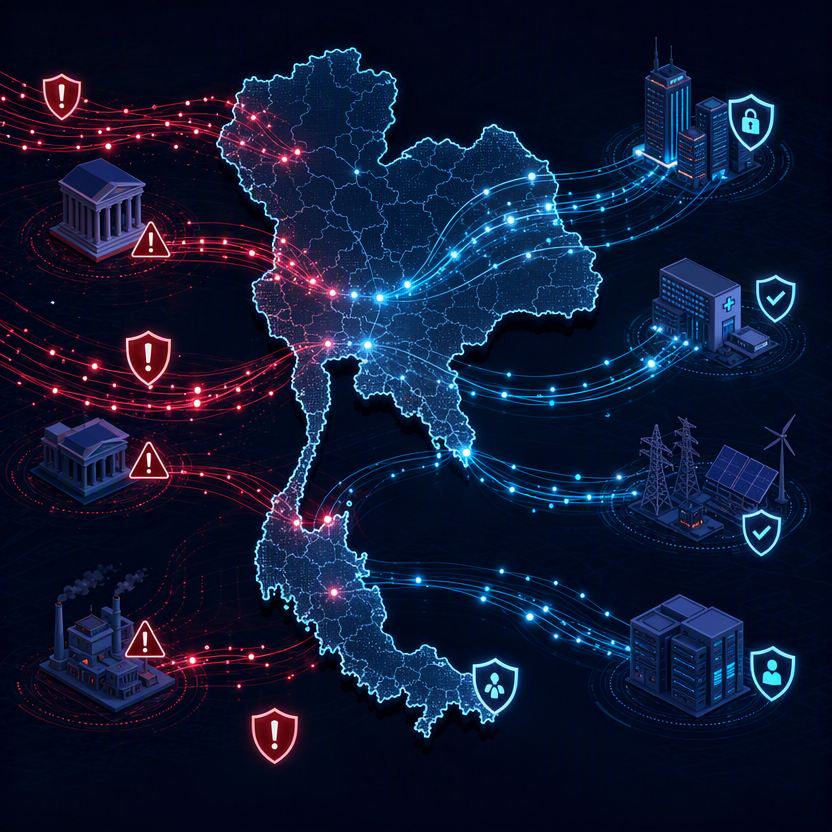
- Data flowing abroad - large volumes of Thai personal data are processed on foreign clouds with no Thai oversight
Homegrown options like Pathumma LLM and Pathumma Connect from NECTEC (NSTDA) are building Thai-language alternatives, but remain far from frontier capability.
Mitigation: Thai organizations should evaluate on-premise Private LLMs or controllable hybrid setups. Read more about Private LLMs
2. Security and privacy risk
- Deepfakes and scams - Thais face rapidly growing fraud using AI-generated voices and videos; cloned-voice scams have cost victims millions of baht
- Automated decisions - AI approving loans, triaging patients or adjudicating cases without human review invites bias and unfairness
- Personal data - embedding AI into government and business systems can spread Thai personal data in ways that may not meet PDPA transparency requirements
3. Economic and employment risk
Recent surveys find roughly 33% of Thai workers fear AI-driven job loss - especially administrative, customer service, accounting and other repetitive roles.
- Most SMEs still lack the skills and capital to benefit from AI
- Thailand faces a shortfall of around 80,000 AI professionals
- Adopting AI faster than the workforce can upskill may widen economic inequality
Mitigation: organizations should invest in AI training for their teams alongside adoption.
4. Infrastructure and energy risk
Rapid data-center investment in Thailand drives up electricity and water demand, with potential long-term energy-security effects - and environmental and local-community acceptance risks are already emerging.
5. Governance and legal risk
The draft AI Act remains under review, with a risk-based approach. The core problems:
- Many public and private organizations adopted AI before rules became clear
- Thailand holds little bargaining power against major technology companies
- Accountability mechanisms for AI failures in critical systems are still missing
Summary: Thailand’s main risks
| Risk type | Level | Thai-specific character |
|---|---|---|
| Sovereignty and control | High | Heavy reliance on foreign models |
| Security and privacy | High | Data easily flows abroad |
| Employment and inequality | Medium-high | SMEs and low-skill workers hit first |
| Infrastructure and energy | Medium | Fast data-center growth |
| Governance and law | High | Rules lag real-world adoption |
Where Thai organizations should start
Thailand’s core risk is not "AI becoming smarter than humans" but embedding technology we cannot fully control deep into critical systems while governance, skills and infrastructure lag behind.
Managed well, AI multiplies productivity and opportunity. Left to drift without direction, these risks become a long-term cost for Thai society.
The Devsign team helps Thai organizations assess readiness and deploy AI safely - from model selection and infrastructure design to AI governance.