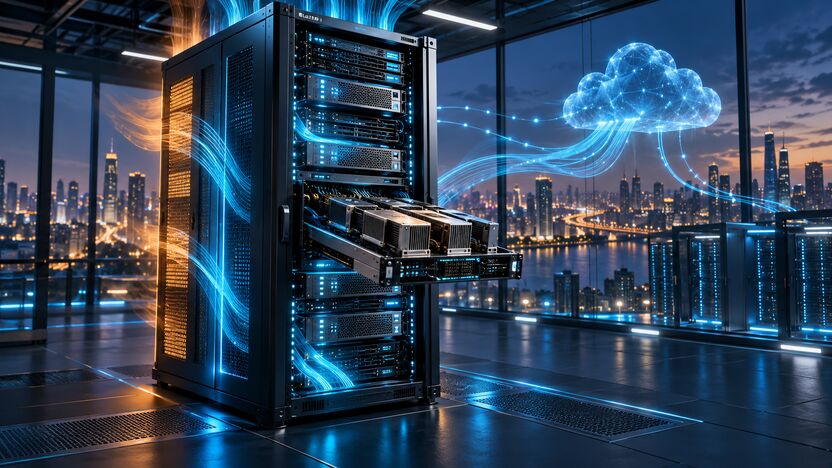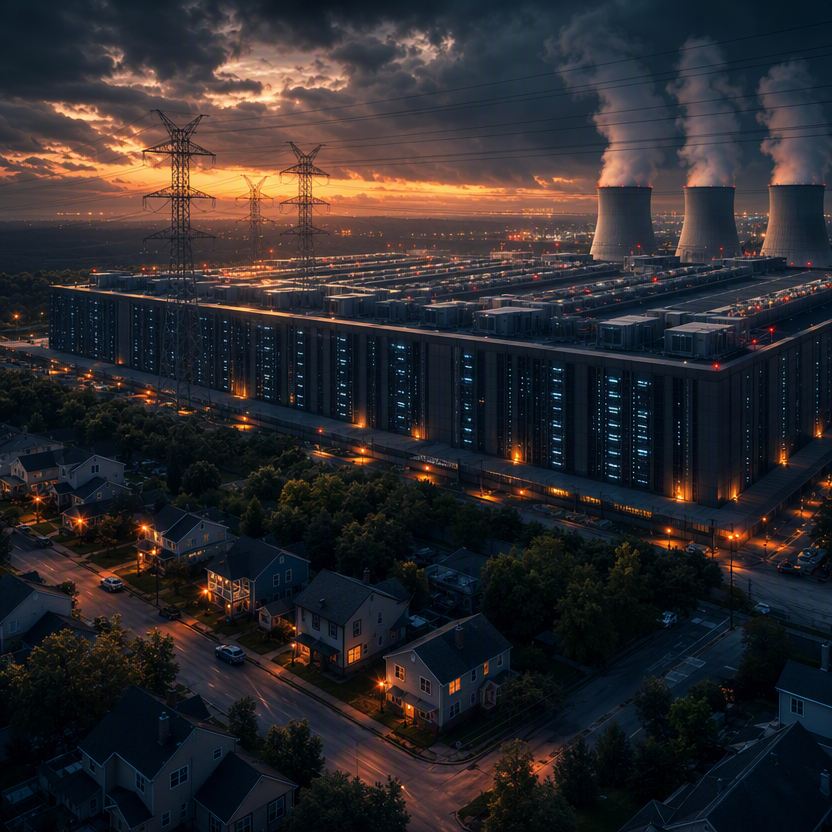
The IEA estimates data centers consumed 415 TWh (1.5% of global electricity) in 2024, while Thailand’s building law still lacks a "Data Center" category - an analysis of what other countries enforce and where Thailand must catch up.
When you open an app to chat with AI or stream video, you rarely picture the "silent factory" behind it - consuming electricity on the scale of an entire city and enormous energy and water resources (depending on size and cooling technology). These are the data centers sprouting worldwide, including in Thailand, where the government is pushing to become a regional cloud hub. Yet Thai building-control law still has no explicit "Data Center" category - so some stand-alone projects, particularly in Bangkok, apply for permits as warehouses.
Behind the cloud: what you never see when using AI
A data center is not just a building with server racks - it is an industrial machine consuming resources around the clock, with three main impacts invisible to most people:
1. Electricity - the enormous appetite
The industry measures efficiency with PUE (Power Usage Effectiveness). A PUE of 2.0 means every watt consumed by servers requires another watt for cooling and other systems.
The IEA estimates data centers consumed about 415 TWh in 2024 - roughly 1.5% of global electricity - rising fast as AI demands massive compute. The follow-on effect is competition for grid capacity with residents, especially where the network is already fragile.
Worse, if the electricity comes from fossil plants, every data center is an indirect giant greenhouse-gas emitter - even with no visible exhaust stacks.
2. Cooling water - the resource that disappears quietly
Servers running constantly radiate intense heat. Some facilities use cooling towers that lose water to evaporation; others use closed-loop, air-cooled or direct-to-chip systems that consume far less water - like the new designs Microsoft has announced.
In many regions - Arizona in the US, parts of Europe - evaporatively cooled data centers have triggered water conflicts with agriculture and households. Discharges of warm water into natural sources can cause thermal pollution, and cooling-tower blowdown may carry minerals and treatment chemicals requiring proper management before release.
Thailand sits in the tropics: year-round heat demands heavier cooling, droughts are increasingly frequent, and letting data centers draw municipal water without limits is high risk.
3. Air and noise pollution - the smokeless factory that hums
While servers have no exhaust pipes, data centers typically run emergency backup generators - from a handful to dozens of diesel units depending on size, power and designed availability - tested regularly. Running them can emit:
- Fine particulate matter (PM2.5) affecting the lung health of surrounding communities
- NOx, PM, CO and other pollutants, with levels depending on fuel type, engine technology, exhaust treatment and runtime
- Noise pollution from giant air intakes running continuously
- Heat-island effects raising surrounding temperatures - which must be assessed site by site
How other countries enforce control
Globally, governments recognize data centers are not ordinary commercial buildings and impose targeted environmental rules:
Singapore: pause-and-tighten model
Singapore imposed a moratorium on new data centers from 2019-2022 over grid and water concerns. In late 2025-early 2026 it reopened applications (DC-CFA2) with at least 200 MW of allocation - attached to strict conditions:
- Platinum Green Mark certification required
- At least 50% clean energy
- Mandatory PUE ≤ 1.25 at 100% IT load - when IT equipment consumes 1 unit, all support systems combined (cooling, UPS, electrical) may add no more than about 0.25 units under the specified measurement conditions
European Union: mandatory public reporting
Under the recast Energy Efficiency Directive (2023-2024), data centers with installed IT power of 500 kW or more must report energy data (per EU Regulation 2024/1364) to a central EU database. The 500 kW threshold refers to installed power for IT equipment, and published figures are aggregated rather than fully site-level detail.
Germany: mandatory waste-heat reuse
Germany goes furthest: data centers entering operation from 1 July 2026 must reuse at least 10% of their waste heat (EnEfG §11), with two years to reach the threshold and conditional exemptions - for example piping heat into district warming for nearby communities or carbon-capture plants.
Thailand’s crisis: when the law calls a data center a "warehouse"
Back in Thailand, despite the cloud-hub ambition, the legal structure has gaps that seriously worry academics and civil society. On 4 September 2026 the issue became a national debate over two blind spots:
Blind spot 1: city planning has no "data center" category
Thai city-planning and building-control law still has no official "data center" classification, so many operators file construction permits as "commercial buildings" or "warehouses" - theoretically low-traffic storage. Latest Bangkok figures cite 6 stand-alone data centers, 3 operating and 3 under review pause (Thairath). This interpretation means:
- Data centers can easily locate in areas unsuitable under city planning
- No dedicated planning review for digital infrastructure
- No appropriate exterior-architecture requirements
Blind spot 2: escaping the EIA
Under Thailand’s natural-resources ministry announcements, stand-alone data centers are not listed as requiring an EIA before construction - even though some store hundreds of thousands of liters of backup diesel (one project was reported at ~400,000 liters pending official verification; the Phra Ram 9 case reportedly held 6 tanks of 40,000 liters each, ~200,000 liters total; actual figures and permit status must be verified per project). Because data centers are judged to have no chemical production process, no EIA is required - despite remaining under building-control and fuel-storage permit law.
Where the looseness leads
The result: data centers appearing inside dense Bangkok communities - prompting political calls (including a People’s Party proposal in September 2026) to classify data centers into S-M-L tiers by electricity use with mandatory EIAs for medium and large projects, and forcing the Bangkok Governor to pause new projects pending five-aspect safety reviews covering water, air and heat pollution plus fire safety around fuel farms.
Conclusion: high technology needs modern law
Data centers are the engine of the AI era - but they are not impact-free structures while they consume city-scale electricity, water for cooling and vast diesel reserves. Thailand’s digital-hub ambition is welcome; without modernizing planning law, enacting clear zoning and raising environmental and EIA rules to international standards, the technological gains may be traded for long-term degradation of water, the power grid and quality of life.
The Devsign team designs data centers and AI infrastructure accounting for PUE, energy use, environmental impact and community safety from the design stage - not as an afterthought.
Sources
- Thairath www.thairath.co.th
- IEA: Energy and AI - Energy Demand from AI www.iea.org
- Microsoft: Zero-water cooling design www.microsoft.com
- Singapore DC-CFA2 (EDB/IMDA) www.edb.gov.sg
- European Commission: Data-centre energy performance energy.ec.europa.eu
- Germany EnEfG Section 11 www.gesetze-im-internet.de