How AI agents differ from chatbots, why organizations worldwide moved to agents for end-to-end automation in 2026, with real deployment examples and guardrails that matter.
Three years ago, asking any company CIO "what AI are you running?" usually meant a chatbot embedded on the website, answering repeated customer questions from a scripted flow. Today the answer has changed. Leading organizations worldwide are deploying AI agents that do not merely answer - they think, plan and execute work to completion.
Where the agent idea comes from
The term agent in AI is borrowed from economics, where an agent is "someone appointed to act on our behalf" - like an insurance broker who does not just recite information but negotiates, prepares documents and closes the deal for us. In AI, the term appeared in 1990s research describing software that acted autonomously on the internet, but it only became truly practical in 2024-2026, once LLMs gained enough reasoning capability to break large jobs into sub-steps and execute them one by one.
Chatbot vs agent: what exactly differs
Think of it like hiring staff:
- A chatbot is like an intern answering a phone line - it replies with whatever the manual contains, and one slightly unusual question leaves it stuck
- An AI agent is like a real executive assistant - say "organize a seminar" and it checks room availability, invites attendees, arranges catering, prepares slides and reminds everyone beforehand, without step-by-step instructions
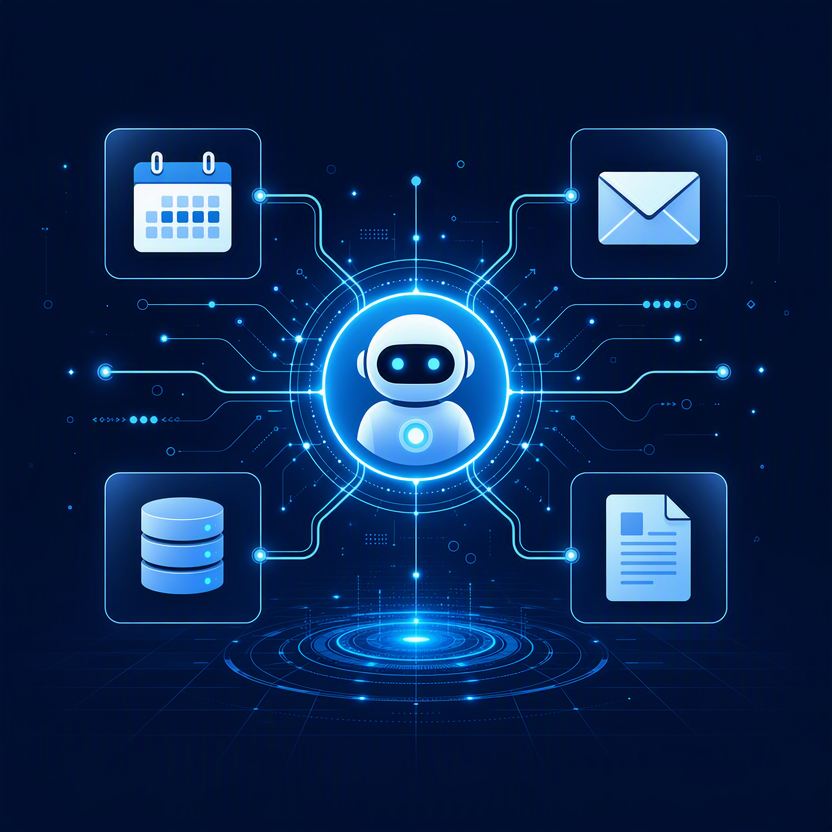
Technically, a chatbot is an LLM answering one question with one response (single-turn). An agent is an LLM working in a loop: think → pick a tool → inspect the result → think again → pick the next tool → repeat until the job is done. Those tools might be API calls, ERP lookups, sending emails or writing files.
What actually works in Thai businesses
From real deployments our team has delivered for enterprise clients, the fastest wins are:
- Accounting - invoice verification agents One client used 3 full-time staff to reconcile invoices against POs daily. An agent that reads PDFs → categorizes → matches against POs → flags only exceptions cut 6 hours of work to 40 minutes, freeing all three people for higher-value analysis
- Sales - pre-meeting research agents Before sending a proposal, reps used to open the CRM + old emails + purchase history + client news - 30-45 minutes each time. An agent does it in 2 minutes and returns a concise brief
- HR - policy Q&A agents Repeated questions like "how many sick days" or "what does the health plan cover" get instant answers grounded in the actual employee handbook with links to source documents - cutting HR interruption work by over 60%
A critical warning: do not give agents too much power
The iron rule we give every client: never let an AI agent press the button that moves money on its own. The right design makes the agent the preparer while a human confirms the final step (Human-in-the-Loop) for high-impact actions such as approving expenses, emailing customers or editing master data.
Design access control from day one (a sales agent should not see payroll data) and audit logs (you must be able to trace what the agent did, when, to which data) in line with PDPA requirements.
Where to start
Our advice: start with one measurable workflow - a document-heavy daily process. Run it for 90 days, measure hours saved, then expand to the next workflow. Avoid launching "AI across the whole organization" first; those projects end with nobody able to say whether anything actually worked.
Devsign designs and deploys AI agents end to end - from connecting legacy data and selecting the right models, to guardrail design and training your team for real adoption.