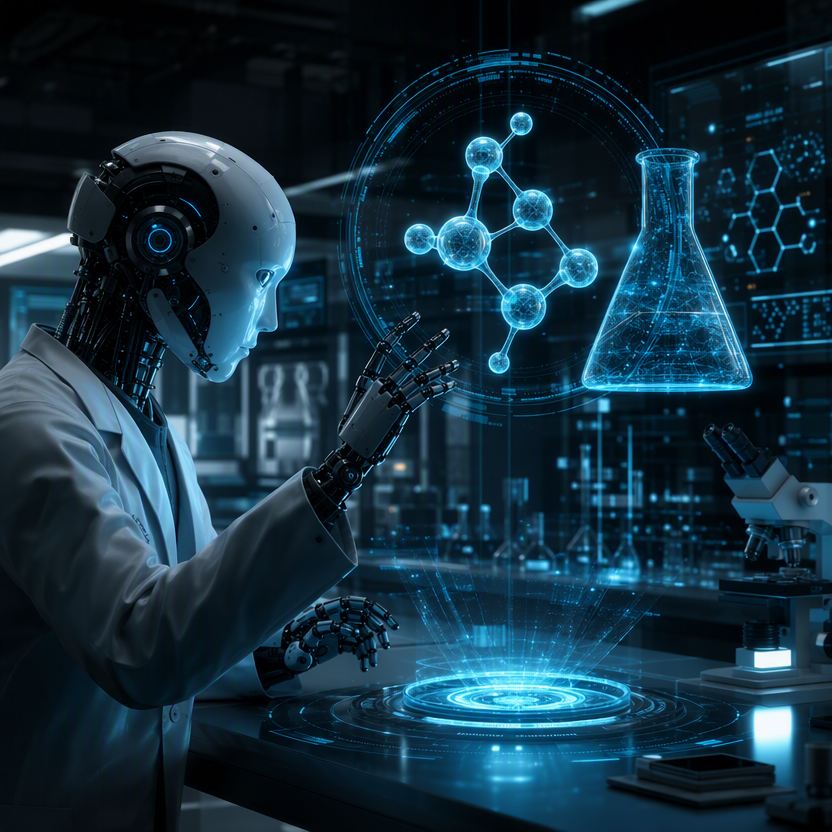
In June 2026, an "Artificial Scientist" demonstrated full-cycle research - hypothesis, experiment design and analysis - without human direction. What it achieved and how the same thinking applies to Thai business R&D.
In June 2026, research shook the scientific world: an AI called "Artificial Scientist" demonstrated the ability to form hypotheses, design experiments and analyze results in a complete cycle without a human telling it what to test. It reasoned on its own that "if this factor changes, the outcome should shift this way" and then designed an experiment to prove it.
What is an Artificial Scientist
The scientific research process has five steps: observe → hypothesize → design experiment → run experiment → analyze results. Traditional AI only helped with the last step (data analysis). Artificial Scientist helps from step 2 onward - reasoning about "why is this happening" and "what should we try next".
The difference from ordinary AI: it does not just answer questions - it poses new questions humans may never have considered, because it sees connections across millions of research papers no human could ever read in full.
Real achievements so far
- Drug discovery - AI designed new molecules for liver cancer treatment, compressing the timeline from 5 years to 6 months by predicting chemical properties more accurately than traditional methods
- New materials - AI discovered superconductors working at higher temperatures, potentially revolutionizing batteries and energy systems
- Physics - AI analyzed particle-collider data and proposed new models explaining phenomena current physics cannot yet account for
- Biology - AI predicted over 200 million new protein structures, foundational for drug and vaccine development
How this relates to Thai business
Most Thai companies are not doing molecular-level research, but the same concept applies to business R&D:
- Food and beverage - AI analyzes recipes, predicts flavors consumers will prefer and suggests new ingredient combinations
- Retail - AI simulates market scenarios and predicts consumer behavior before committing to a new store or product launch
- Construction - AI designs stronger structures using less material by simulating millions of stress scenarios
The infrastructure challenge
AI research demands enormous compute for both training and simulation. Choosing the right GPU cluster architecture and storage system matters enormously. Read more about AI infrastructure and data centers we provide.