Why does the same model give different results through different agents? Inside DeepSeek Harness (dsh), the open-source everything-is-a-plugin agent runtime on the Cordis framework - compared with Claude Code, Codex, and OpenCode across architecture, four modes including PTC, cost per mission, and the CVE-2026-82533 risk.
AI coding agents are no longer just autocomplete tools. We can ask AI to read an entire project, analyze failures, fix source code, run tests, or even build new features from a few sentences. Claude Code, Codex, and OpenCode have become part of many developers’ daily workflow.
But one question stands out: why does the same AI model produce different results when run through different agents? Some tools handle large projects well, some burn enormous tokens, some fix bugs persistently while others get stuck calling the same tool over and over. The answer lies not only in the model but in what is called the harness - the system that lets AI actually act. That is the idea behind DeepSeek Harness (dsh), an open-source project from DeepSeek presenting a different way to design AI agents.
What is a harness, and why does it matter?
Imagine asking AI to add two-factor authentication (2FA) to an existing website. The AI must do more than write code: read the project structure, understand the existing login system, inspect the database, modify both frontend and backend, then run tests to confirm nothing broke. Along the way it must decide which file to read first, which tool to call, whether a command needs approval, and how to recover from errors. All of that is the harness’s job.
If the AI model is the brain, the harness gives that brain tools, memory, and boundaries for taking action. Simply put: AI Agent = AI Model + Harness. A brilliant model with poor tool management can perform worse than a lesser model in a well-arranged environment. That is why choosing an AI coding agent should not be only about which model it uses, but how well it manages tools, context, continuity, and safety.
How DeepSeek Harness differs
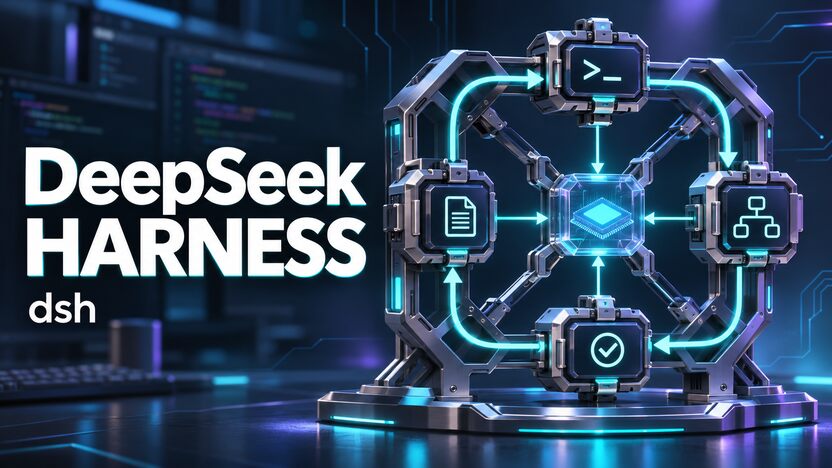
DeepSeek Harness is an open-source AI agent runtime under the MIT License - developers can study, modify, and extend it. The core idea: Everything is a Plugin.
Most AI agent tools have a fixed core and let developers add capability through plugins, skills, or hooks. DeepSeek Harness goes further: many structural components are swappable plugins - the model connection, tool management, session persistence, system prompt assembly, sandboxing, even the agent loop that governs the AI’s workflow.
The heart of this architecture is a framework called Cordis, which acts as the central system for assembling plugins and managing their relationships (see the architecture documentation). Two key concepts:
- Spatial Composability - plugins declare which services they depend on; for example, a file-editing tool needs the filesystem service. When the service is ready, dependent plugins can start.
- Temporal Composability - plugin lifecycle management; whatever a plugin registers can be cancelled or cleaned up when it is removed or reloaded.
The benefit: developers can swap system components without rewriting the core. If an organization wants agents to run in a sandbox on a separate server, they can build or pick a plugin that changes filesystem access and command execution. If you want GitHub Actions checks before the agent summarizes work, add a specialized plugin. This is the key difference between installing plugins to extend an agent and using plugins as building blocks for constructing an agent runtime. That said, swappability does not mean every plugin works together instantly - dependencies, permissions, and integration testing remain the developer’s job.
The four modes of DeepSeek Harness
| Mode | Strength | Best for |
|---|---|---|
| Standard | Full toolkit for general work | Coding and everyday tasks |
| PTC | Programs orchestrating multi-step tool calls | Complex work with many tool calls |
| Minimal | Restricted environment and tools | Benchmarks and model testing |
| Creator | Inspect and extend the runtime with plugins | Building custom AI agents |
The most interesting mode is PTC (Programmatic Tool Calling) (see the tool registry documentation). Imagine AI inspecting 100 source files. Normally it would call search, read a file, receive results, decide, and call again - many rounds. PTC lets the model write a program that orchestrates several tools in a single step, returning only the relevant results for the model to process. Instead of shuttling data between model and tools dozens of times, some steps run directly in the execution environment. This can reduce model calls and repeated tokens - but it is not automatically faster or cheaper; it still depends on the model’s ability and the nature of the task.
Another mode, Creator, lets developers inspect the runtime structure and write additional plugins - making DeepSeek Harness not just a tool for AI coding but an environment for building new AI agent tooling.
DeepSeek Harness vs Claude Code vs Codex vs OpenCode
Once you understand the concept, the question is whether it beats the tools you already use. The answer depends on whether you want a ready-made coding tool or a platform for building and controlling AI agents yourself.
| Topic | DeepSeek Harness | Claude Code | Codex | OpenCode |
|---|---|---|---|---|
| Open source | MIT | Not fully open | CLI and key parts open | Open source |
| Core approach | Modular agent runtime | Coding agent | Coding agent | Multi-provider coding agent |
| Model choice | Many providers | Claude-focused | OpenAI-focused | Many providers |
| Customization | Runtime and plugin level | Skills, Hooks, MCP, Plugins | Skills, MCP, Config | Plugins, Tools, Config |
| Main surfaces | Web, Desktop, CLI, SDK | Terminal, IDE, Desktop | CLI, IDE, App | Terminal, Desktop, IDE |
| Building new runtimes | Core strength | Not the main goal | Not the main goal | Extensible, but has its own core |
| Best fit | Experimenting and building agent platforms | Coding with Claude | Coding with OpenAI | Multi-model coding and self-hosted workflows |
This table compares design approaches and headline capabilities, not speed or model accuracy results.
Claude Code (official docs) focuses on the software development experience: tools for reading and editing code, managing terminal commands, connecting external systems via MCP, and defining workflows through skills and hooks. The advantage is starting work on a project immediately without designing the agent architecture yourself - suited to developers using Claude against a real codebase.
Codex (official docs) from OpenAI shines in integration with development tooling - CLI, IDE, and environments that support delegating work to an agent. It defines sandboxes and approval policies for controlling command execution and supports skills and external tool connections. Suited to teams on OpenAI services who want an agent without building a runtime.
OpenCode (official docs) is an open-source coding agent that emphasizes flexible choice of models and providers. Developers can connect multiple providers and pick the right model per task - useful for mixing a strong reasoning model for hard work with a cheaper one for routine tasks.
DeepSeek Harness differs by letting developers reach deeper into the runtime’s internals than typical ready-made agents. Instead of choosing only a model and toolset, you design how sessions, tool execution, the agent loop, and other runtime components work. It suits those building their own AI agent platform. The project is still in developer preview, so architectural flexibility should not be assumed to automatically mean better performance or stability.
And costs - which is worth it?
Cost must be unpacked carefully: model pricing, token volume, API call counts, and infrastructure all add up. DeepSeek Harness aims to reduce token usage through tool-calling management and compatibility with lower-cost models; PTC in particular can cut the cost of repeatedly shipping context. But understand this first: cost per million tokens is not cost per completed mission.
Suppose Agent A costs only $0.20 per attempt but needs 5 attempts to fix a bug - total $1. Agent B costs $0.60 but fixes it on the first try. Here B has a lower cost per mission. Subscriptions and direct API billing are also different cost shapes - do not compare monthly package prices with token prices directly. For a serious comparison, measure at least four variables: success rate, total token usage, execution time, and cost per successful task. There is not yet sufficient independent benchmark evidence that DeepSeek Harness is cheaper than the others in every scenario.
Security: what to think about before giving AI control of your machine
Flexibility is a double-edged sword. An agent that reads files, runs a terminal, and connects APIs carries far more risk than a chatbot. The project’s SAFETY.md states plainly that the system has not undergone a formal security audit, and that sandbox or approval mechanisms cannot guarantee complete isolation.
One important example is CVE-2026-82533 (CVSS 9.4) (security advisory) affecting an older version: validation of requests to the local HTTP API trusted the host header, combined with sandbox restrictions that still allowed access to the machine’s internal network. Together these opened a path to bypass the agent’s permission controls. It has been fixed, but it is a good illustration that designing sandboxes for AI agents is hard and single-layer defenses may not be enough.
Anyone experimenting should run in a separate VM or container, use least-privilege credentials, keep agents away from production data, and audit external plugin source code before installing. Also mind internal data: letting an agent read your source code or documents does not mean every kind of data may flow out to external model providers. Consider data privacy policy, log retention, and what the model can access - together, always.
Getting started with DeepSeek Harness
You can try it via npm:
npx @deepseek-ai/dsh webOn success it opens a web UI locally at http://127.0.0.1:3080 by default, where you configure model providers and start experimenting (check the Node.js requirements in the official docs first). To study the architecture or build plugins, clone the source:
git clone https://github.com/deepseek-ai/deepseek-harness.git
cd deepseek-harness
pnpm install
pnpm run build
pnpm dsh web
For a first experiment, use a sample project with no credentials or sensitive data - learn how permissions and the agent’s behavior work before touching real work.
Conclusion: should you switch?
If you want an everyday AI coding agent, Claude Code, Codex, and OpenCode remain strong choices depending on your models and workflow. But if you want to build your own agent platform, swap runtime components, or experiment with new approaches to tool and context management, DeepSeek Harness is a fascinating project. Do not judge by GitHub stars or token-saving claims - test against real work, measure outcomes, and assess the system’s risk.
The best AI agent does not need the smartest model or the most plugins. It is the system that completes work correctly, at reasonable cost, with auditability, and without risk beyond what the organization accepts.
DeepSeek Harness may not directly replace Claude Code, Codex, or OpenCode - but it points at where AI agents are heading: competition is no longer just about models, but about the architecture of the system that lets models act.
Sources
- DeepSeek Harness (dsh) github.com
- Cordis github.com
- architecture documentation github.com
- tool registry documentation github.com
- official docs code.claude.com
- official docs developers.openai.com
- official docs opencode.ai
- SAFETY.md github.com
- security advisory github.com