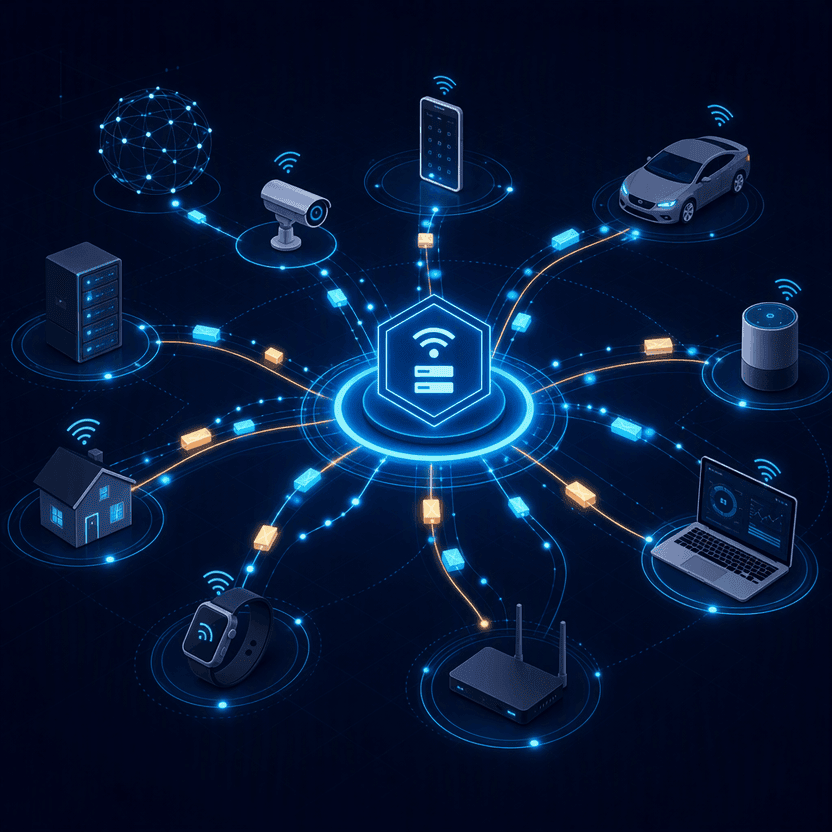
Why MQTT dominates IoT and real-time backend architecture - the publish/subscribe model explained with a production fleet tracking example covering QoS, retained messages, shared subscriptions and scale.
When thousands of vehicles, sensors or devices need to send data in real time, HTTP request-response breaks down. MQTT (Message Queuing Telemetry Transport) is the lightweight publish/subscribe protocol that powers real-time backends at scale.
Why not just use HTTP?
HTTP works for "client asks, server responds". But real-time systems need the opposite: devices push data continuously and multiple consumers react to it. HTTP polling wastes bandwidth and adds latency. MQTT solves this with a persistent connection and a broker that routes messages to whoever subscribed.
Core concepts
- Broker - the central hub that receives all messages and routes them to subscribers (Mosquitto, EMQX, HiveMQ)
- Topic - a hierarchical address like
fleet/vehicle-123/gpsthat messages are published to - Publish - a device sends a message to a topic
- Subscribe - a consumer registers interest in topics (supports wildcards like
fleet/+/gps) - QoS - quality of service levels: 0 (fire and forget), 1 (at least once), 2 (exactly once)
Production example: fleet tracking
Imagine tracking 1,000 delivery vehicles in real time:
- Each vehicle publishes GPS + speed + fuel to
fleet/{vehicle-id}/telemetryevery 5 seconds - The tracking dashboard subscribes to
fleet/+/telemetryto display all vehicles on a live map - The alerting service subscribes to
fleet/+/alertfor speeding or geofence violations - The analytics service subscribes to all topics and writes to a time-series database
Each consumer receives exactly the data it needs without the vehicles knowing who is listening.
Advanced patterns
- Retained messages - the broker stores the last message per topic, so new subscribers immediately get current state (e.g. last known GPS position)
- Shared subscriptions - multiple instances of the same consumer share the load (e.g. 4 alert processors each handle 1/4 of messages)
- Last Will and Testament (LWT) - if a device disconnects unexpectedly, the broker publishes its pre-set "will" message, triggering offline alerts
- Persistent sessions - devices that reconnect receive messages queued while they were offline
Scaling considerations
- Single broker handles 100K+ concurrent connections (EMQX, VerneMQ)
- Cluster mode distributes load across nodes for millions of connections
- Bridge mode connects brokers across geographic regions
When to choose MQTT
| Requirement | Best protocol |
|---|---|
| Thousands of IoT devices pushing telemetry | MQTT |
| Browser clients receiving real-time updates | WebSocket / SSE |
| Event-driven microservices | Kafka / NATS |
| Simple request-response | HTTP |
Devsign builds real-time backend systems with MQTT, WebSocket and event-driven architectures for IoT and tracking platforms.